
Integrating Willo into Everyday Patient Care

The families in this series did the slow work of building tolerance over years. Your part at the chair is more immediate. It means recognizing the moment a patient is ready for a tool that fits, and making the introduction land as an extension of the home care conversation you are already having.
That conversation carries real clinical weight.

Two subgroups face especially high risk: people with Down syndrome and people who cannot easily tolerate routine dental care.² That second group is exactly who benefits when daily home care becomes more achievable. Caregivers carry most of that daily work, and caregiver burden is a documented barrier to consistent oral care for this population.⁴ When you recommend Willo, you are addressing that barrier, so make the connection explicit.
Start with the barrier
During home care review, ask about brushing specifically. Broad questions (“How is brushing going?”) tend to produce broad answers. Targeted questions surface the barrier you can actually solve:
- “Who does most of the brushing at home, and how is that going for them?” (caregiver fatigue)
- “Does brushing ever turn into a struggle, or get skipped on the hard days?” (resistance, consistency)
- “Are there textures, sounds, or sensations near the mouth that are hard to tolerate?” (sensory sensitivity)
- “Is gripping or maneuvering the brush part of the difficulty?” (motor limitations)
These are the patients Willo was built for. Naming the barrier aloud also signals to the caregiver that you see the effort they are already putting in, which is often the first time a clinician has acknowledged it.
Frame Willo as relief for an overstretched routine
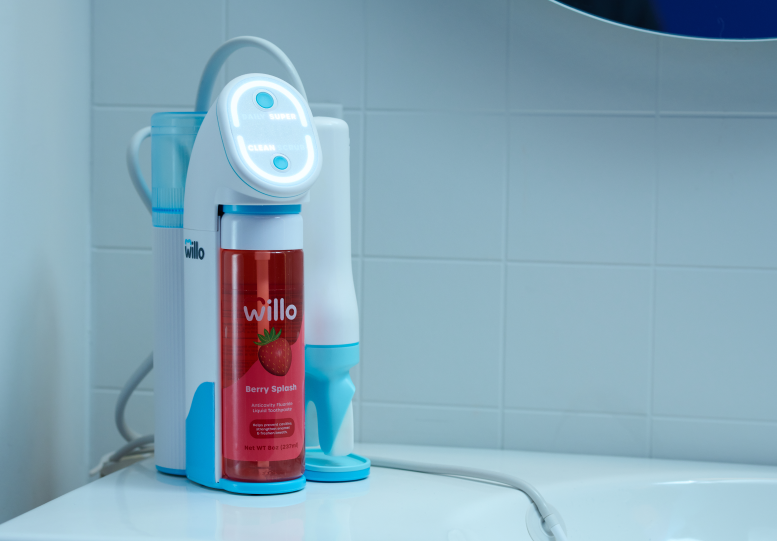
A tired caregiver is looking for relief, and the most persuasive thing you can offer is a way to make the routine they already manage take less effort. When you introduce the Willo BrushBot, tie it to the specific barrier the caregiver just named:
- Caregiver fatigue: “This handles the brushing motion for you, so the part that takes the most effort is done.”
- Sensory sensitivity: “The foam head gives a softer, more predictable sensation, which many children with sensory sensitivities tolerate better than bristles.”
- Technique and consistency: “It does not depend on getting the angle right every time, and the app shows you whether brushing is actually happening.”
Keep the framing patient-centric and honest. You are offering a tool that removes friction from a routine the family is already working hard to maintain.
Make starting frictionless
No inventory, no extra steps for your practice:
- Share your practice QR code chairside, or send it home with the caregiver.
- They enter your practice code on the Willo website for a coupon toward their purchase.
- Set the expectation now that you will follow up at recall, the same as any home care recommendation.
Close the loop at recall
Recall is where a recommendation becomes a routine, and where coordinated, ongoing care does its work for patients with IDD.⁵ Review Willo the way you would any home care change. Ask what is working, troubleshoot what is not, and invite caregivers to bring their app data (brushing frequency and duration) so you can review it together. Shared data turns a subjective “we’re trying” into an objective picture you can both act on, and seeing progress reinforces the caregiver’s effort and keeps the routine going.⁶

“A 30 second conversation and a QR code are all it takes to connect a patient with better home care.”
References
1. Disability impacts all of us infographic: disability and health [Internet]. Atlanta (GA): CDC; 2024 [cited 2025 May 6]. Available from: https://www.cdc.gov/disability-and-health/articles-documents/disability-impacts-all-of-us-infographic.html
2. Anders PL, Davis EL. Oral health of patients with intellectual disabilities: a systematic review. Spec Care Dentist. 2010;30(3):110-117.
3. Lamster, I. B., DePaola, D. P., Oppermann, R. V., Papapanou, P. N., & Wilder, R. S. The relationship of periodontal disease to diseases and disorders at distant sites: communication to health care professionals and patients. J Am Dent Assoc. 2008;139(Suppl):138S-153S.
4. Lee J, Chang J. Oral health issues of young adults with severe intellectual and developmental disabilities and caregiver burdens: a qualitative study. BMC Oral Health. 2021 Oct 18;21(1):538.
5. Keller SM. The importance of integrated care for individuals with intellectual and developmental disabilities. Compend Contin Educ Dent. 2023 Mar 1;44(3):166-168.
6. Wilson NJ, Lin Z, Villarosa A, et al. Countering the poor oral health of people with intellectual and developmental disability: a scoping literature review. BMC Public Health. 2019 Dec;19(1):1-16.


