
If Your Child Can’t Write Neatly Yet, They Probably Can’t Brush Their Teeth Well Either

Brushing teeth requires the same fine motor skills as handwriting. Here’s why most kids aren’t developmentally ready to do it well and what that means for parents.
Key takeaway
A toothbrush requires the same control as a pencil and brushing well is often even harder.
If your child is still learning to write neatly, they are still learning the skills needed to brush their teeth effectively.
Once you see the connection, it changes how you think about brushing.
A toothbrush is basically a pencil
Think about how your child holds a pencil.
It’s a small object that requires:
- Precise finger control
- Consistent pressure
- Careful movement across a surface
Now think about a toothbrush.
It’s the same type of tool, just used inside the mouth instead of on paper.
And in many ways, it’s harder.
Instead of seeing what they’re doing clearly, kids are brushing by feel. They have to reach around teeth, stay along the gumline, and cover every surface.
That requires even more coordination than writing.
What handwriting teaches us
Handwriting is one of the most studied fine motor skills in child development.
It depends on coordination between the hands, fingers, and visual system, and develops gradually over several years (Feder & Majnemer, 2007).
That’s why we expect handwriting to be messy at first.
We expect uneven letters. Inconsistent spacing. A lot of practice.
Because we understand that skill takes time.
Where the expectation breaks down
With brushing, the expectation is completely different.
We expect kids to clean every surface of every tooth, thoroughly, twice a day.
Even though it requires the same level of control as handwriting.
And often more.
The “oh wow” moment
If your child’s handwriting is still developing…
If letters are uneven or hard to read…
If writing neatly takes focus and effort…
Then it makes sense that brushing thoroughly is also hard.
Not because they don’t care.
Not because you haven’t taught them.
But because they’re still developing the coordination to do it well.
What the research tells us
Fine motor skills continue developing throughout early and middle childhood.
At the same time, dental research shows that manual dexterity plays a key role in effective toothbrushing.
In simple terms:
Better control leads to better cleaning.
What this means for parents
If brushing has felt inconsistent or frustrating, it doesn’t mean your child is behind.
It means they’re still developing a complex skill.
The goal isn’t perfect technique right away. It’s making sure teeth are getting clean while those skills are still developing.
Why the tool matters
Most traditional toothbrushes assume the same level of control as writing neatly with a pencil.
But many kids are still learning that skill.
That doesn’t make them careless. It means the expectation is ahead of development.
Final thoughts
Kids don’t learn handwriting overnight.
They won’t master brushing overnight either.
But once you understand that brushing is a fine motor skill, the struggle starts to make sense.
And you can start thinking less about effort and more about support.
A more reliable way to get clean teeth
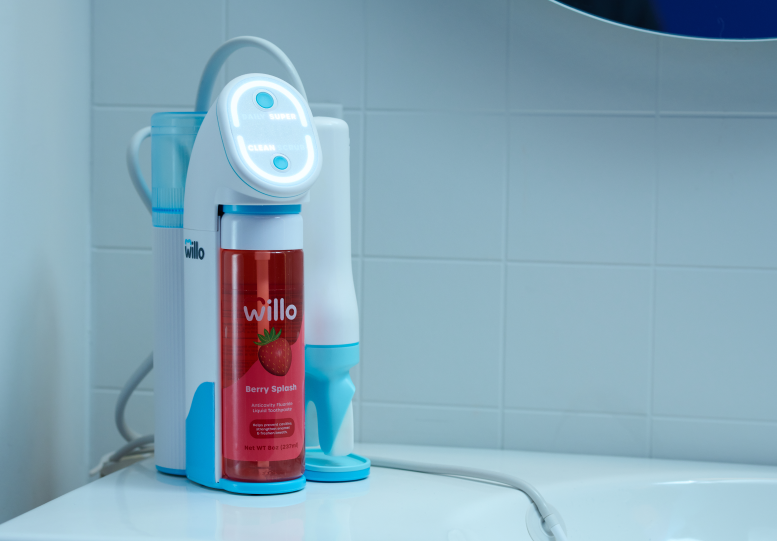
Kids will learn to brush over time. In the meantime, they still need a thorough clean. See how Willo helps take the guesswork out of brushing.
Compare Willo models

