
When “They Brush Every Day” Doesn’t Match What You See

What one dentist's plaque-disclosing experience reveals about pediatric home care
It is a familiar conversation in pediatric dental care: a parent reports that their child brushes every day, but the plaque pattern suggests the home routine is not producing the clean everyone expects.
That does not necessarily mean the child is not brushing. The more useful question may be whether the brushing they are doing is actually effective.
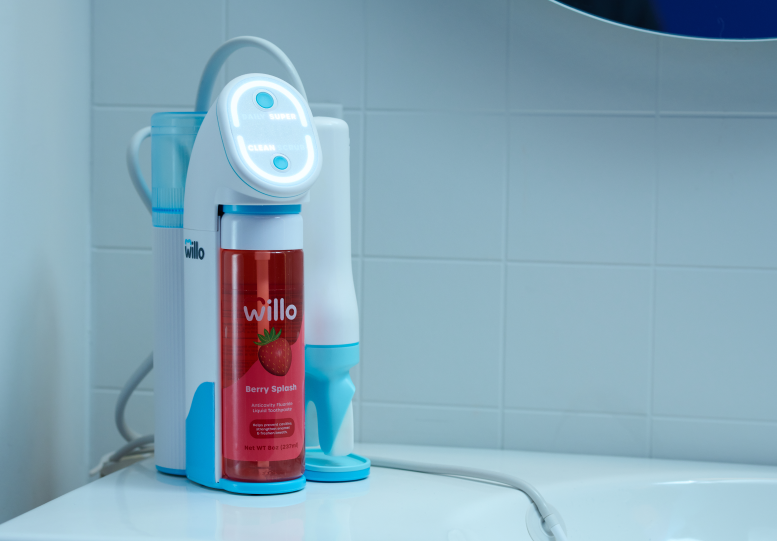
Dr. Astrid Gonzalez, DDS, a dentist at Tiny Teeth of Tally and a mother, decided to make that distinction visible at home. After a full day of birthday cake and candy, she used a plaque-disclosing product on her son’s teeth, had him brush with Willo, and disclosed again.


In the areas pictured, the visible purple plaque present before brushing was removed after her son used Willo.
It was a simple at-home demonstration, not a clinical study. But it illustrates a challenge dental professionals see every day: brushing frequency does not necessarily equal brushing efficacy.
For pediatric patients, the gap often comes down to what we are asking children to manage on their own. Effective traditional brushing requires consistent positioning, coverage, movement, duration, attention, and dexterity—variables that can change dramatically from one brushing session to the next.
So when plaque persists despite reports of regular brushing, repeating “brush better” may not always address the real barrier.
Making the invisible visible
Plaque disclosure gives clinicians and families a way to move the conversation from whether brushing happened to what brushing actually accomplished.
A child may brush twice a day and still consistently miss posterior, interproximal, gingival, or other difficult-to-reach areas. Younger children may lack the dexterity to manipulate a traditional toothbrush effectively. Older children may have the motor skills but rush, become distracted, or perform the routine inconsistently.
Seeing those patterns can change oral hygiene instruction. Instead of another general reminder about two-minute brushing, the clinician can identify where the routine is breaking down and consider what would make effective cleaning more achievable for that particular child.
When technique is variable
Manual and conventional powered toothbrushes still rely substantially on the user to position and move the brush effectively throughout the mouth.
Willo approaches the problem differently by powering the brushing motion rather than relying on the child to manually reproduce traditional brushing movements. The goal is to reduce how much the outcome depends on variables children may struggle to control consistently, including dexterity, positioning, attention, pace, and technique.
In separate clinical testing, Willo has been shown to remove up to 7x more plaque than manual brushing in hard-to-reach areas.
Dr. Gonzalez’s plaque-disclosing demonstration is not evidence of that clinical result; it is one family’s real-world experience. But together, the two raise an important question for pediatric home-care recommendations: when technique is the point of failure, could reducing reliance on technique improve the routine?
The outcome beyond plaque
For Dr. Gonzalez, what changed was not limited to what she saw on her son’s teeth.
As a dentist, she was interested in cleaning efficacy. As a parent, she was equally interested in what it took to achieve that clean twice a day.

“My kid loves this! And it honestly saves me so much time and headache. This product helps maintain the relationship I have with my kids because it’s one less thing I have to do to them! I also think it’s perfect for combination with SDF/elevate products and/or a xylitol regimen.”
Her experience points to another consideration that may not appear on a plaque score: how much parental intervention does the home-care routine require?
When effective brushing depends on repeated prompting, supervision, correction, or a parent physically taking over, the routine can become a source of friction. A tool that allows a child to take greater ownership while still supporting effective cleaning may change more than oral hygiene.
A different conversation with families
When the clinical picture does not match the home-care history, the answer is not necessarily more instruction.
It may be worth asking:
- Where is plaque consistently being left behind?
- Is dexterity limiting effective positioning or movement?
- Is the child capable of the technique but inconsistent in performing it?
- How much supervision or hands-on help is the parent providing?
- Could a tool that reduces reliance on brushing technique make effective home care more achievable?
Those questions shift the conversation from compliance to capability.
Because when a parent tells us, “They brush every day,” both things can be true: the child may be brushing every day, and the routine may still need a different solution.
That is where dental professionals can make the difference, not simply by asking families to brush more, but by helping them find a home-care routine that works.


