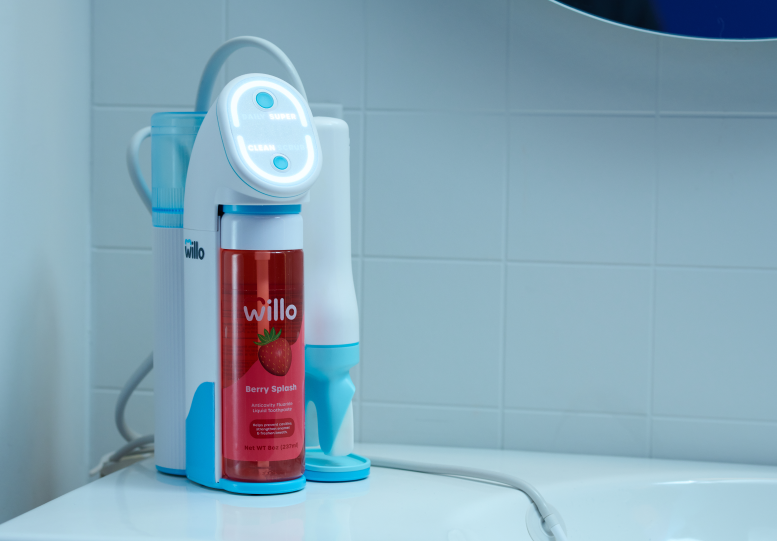

Getting Ahead of White Spot Lesions For Ortho

A practical look at where hygiene breaks down during orthodontic treatment, and how a technique-free approach helps your patients close the gap.
White spot lesions remain the most common iatrogenic risk of orthodontic treatment, and nearly half of patients are at risk during care.¹ They tend to appear in a predictable place. The maxillary canines and lateral incisors (teeth 6 through 11) are where patients most often fail to clean, because reaching those surfaces at the correct angle around a bracket demands more manual skill than the posterior teeth or central incisors require.
Willo developed its Ortho brush head in collaboration with Dr. Andrew Serrano, DMD, MPH, a board-certified orthodontist and Diplomate of the American Board of Orthodontics. He describes the underlying challenge plainly. Brackets, he notes, “create a surface that is very hard for patients to clean,” and “removing the plaque and tartar around the bracket is critical to preventing white spots, which is the scarring we see.”
The insight worth carrying into patient conversations.
Poor bracket-area hygiene is usually a technique problem rather than a motivation problem. Many adolescents brush twice a day for the full two minutes and still develop demineralization, because they cannot manipulate a manual or power brush to the roughly 45 degree angle that effective bracket cleaning requires. As Dr. Serrano observes, “sometimes they are able to brush every day, but the challenge is brushing with the proper technique to clean the food and debris away from the brackets.” When we treat the issue as effort, we miss the mechanism. When we treat it as a technique, we can actually solve it.
“The idea of the Willo toothbrush is that you are taking the technique away from the patient. All of the technique is built into the toothbrush, and it becomes very easy for them to comply, cooperate, and prevent white spots from forming.”
Dr. Andrew Serrano, DMD, MPH · Diplomate, American Board of Orthodontics
Where hygiene breaks down
The pattern is consistent across young patients. “Kids are really good at brushing the back teeth and usually the front two teeth,” Dr. Serrano explains. “The central incisors are easy to keep clean. It does not require as much technique.” The difficulty concentrates on the canines and lateral incisors, where the brush has to arrive at a precise angle around the bracket. Patients “cannot manipulate the toothbrush head to that angle to remove the debris around the brackets,” he notes, which is why they “are not as good at cleaning around the upper laterals and canines.” Those are exactly the surfaces where white spot lesions most often form.²
Removing technique from the equation
The Ortho brush head is engineered to reach those surfaces for the patient. A dedicated bracket slot lets the head keep contact with the tooth without catching on the appliance. A recessed middle row of bristles cleans above, on, and below each bracket. A raised fourth row running canine to canine reaches from the bracket to the gingival margin across the high-risk anterior zone. The automated motion replicates the Modified Bass Technique for a full two minutes. “The toothbrush fits semi-custom around the arch,” Dr. Serrano says. “It brushes that area as well as it brushes everywhere else.” The result is 5x greater plaque removal from the bracket-to-gingival margin versus manual brushing, with 87 percent of users completing the full routine.³˒⁴
Putting it to work in your practice
● Prioritize the patients who need it most. Adolescents in active treatment, patients with special healthcare needs who cannot physically manipulate a brush, and children with sensory sensitivities benefit most directly. The built-in timer also answers a complaint Dr. Serrano hears from parents daily: “Johnny brushes his teeth for 10 seconds and walks out of the bathroom.”
● Choose an integration point. Embed Willo into the treatment plan so patients start with consistent home care from Day 1, or place it selectively with the high-risk patients who drive repeated oral hygiene instruction and chairtime.
● Keep the recommendation clinically honest. Willo replaces the manual or technique-dependent power toothbrush. Flossing and interdental aids remain essential, which is why the Ortho kit includes braces flossers to reinforce that habit.
His coaching philosophy is worth carrying into every operatory conversation. “Most people, if they understand why they are doing something, are able to complete the task much better,” Dr. Serrano says, and they do it more consistently. When the device makes the correct routine the default, the team spends less time correcting mechanics and more time reinforcing that understanding.
CLINICAL TAKEAWAYWhen a patient keeps accumulating plaque around brackets despite brushing, resist the reflex to repeat the same oral hygiene instruction. Ask whether the barrier is effort or execution. If it is execution, a technique-free tool addresses the mechanism directly, and frees your chairtime for the work only a clinician can do: risk assessment, motivation, and individualized prevention. |
SOURCES
1. Sundararaj D, Venkatachalapathy S, Tandon A, Pereira A. Critical evaluation of incidence and prevalence of white spot lesions during fixed orthodontic appliance treatment: a meta-analysis. J Int Soc Prev Community Dent. 2015;5(6):433-439. Pooled incidence of new lesions during treatment was 45.8 percent across 14 studies.
2. Khalaf K. Factors affecting the formation, severity and location of white spot lesions during orthodontic treatment with fixed appliances. J Oral Maxillofac Res. 2014;5(1):e4. Maxillary canines and lateral incisors were the most affected teeth, the gingival margin the most affected surface, and poor oral hygiene the strongest risk factor.
3. 5x greater plaque removal from the bracket-to-gingival margin versus manual brushing: data on file, Willo, 2026.
4. 87 percent of users completed the full two-minute routine: data on file, Willo, 2026.


